Rhodes: a medieval city with an airport attached
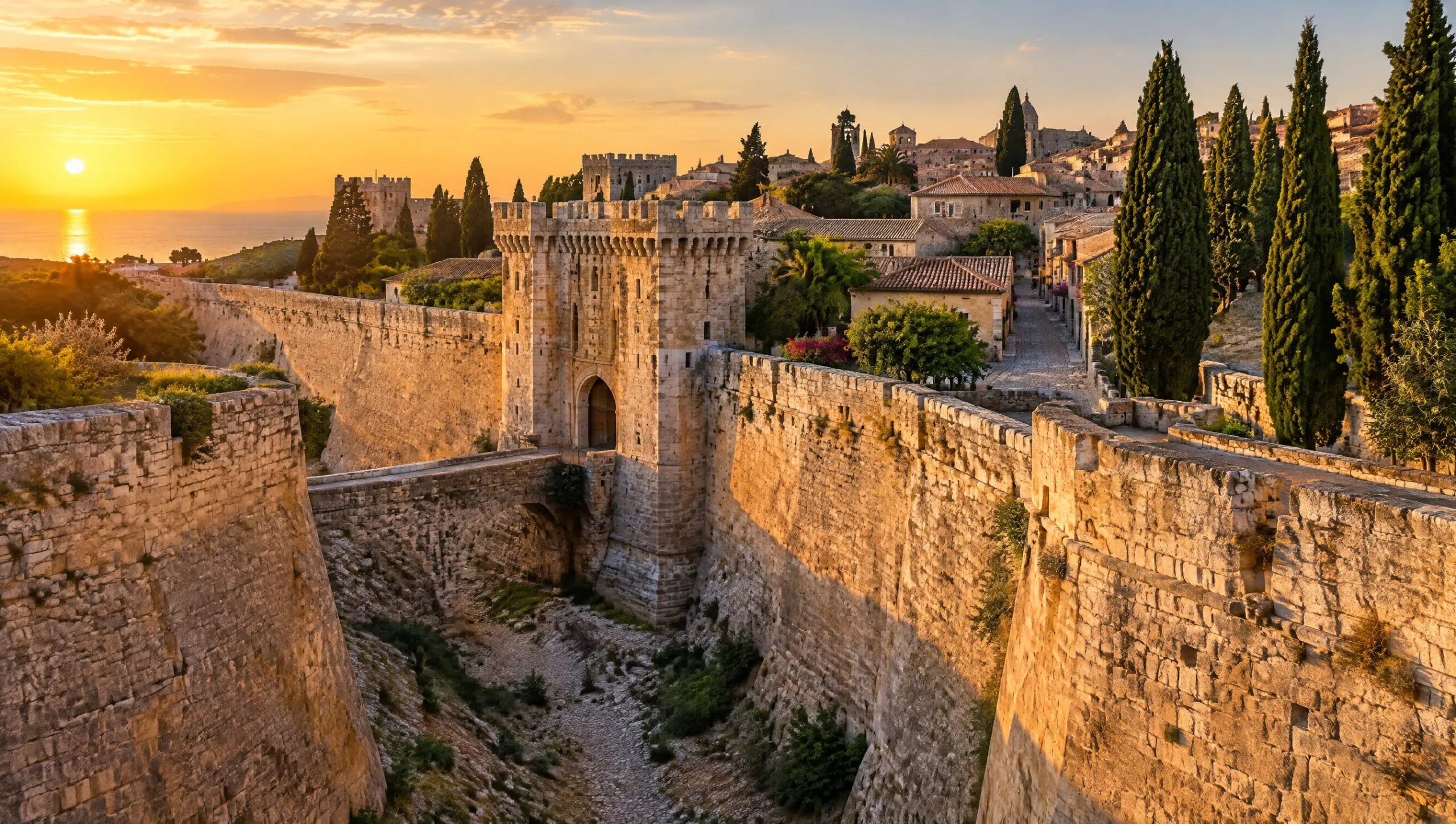
Rhodes has one of the longest seasons in Greece, one of the busiest airports in the country, and the largest inhabited medieval town in Europe. More than six thousand people still live inside the walls the Knights of St John built from the fourteenth century — four kilometres of them, with a moat, a palace and a street of inns, inscribed by UNESCO in 1988. Very little else in the Mediterranean compares.
We currently list 0 properties in Rhodes, and we are actively looking for more.
Three layers of history, all still standing
The Knights held Rhodes from 1309 until the Ottomans took it in 1522, and the Old Town is essentially theirs: the Street of the Knights, the Grand Master’s Palace, the gates. The Ottomans added mosques and hammams. Then the Italians held the Dodecanese from 1912 to 1943 and rebuilt the new town in rationalist and Art Deco stone — the markets, the administrative buildings along Mandraki harbour, the Grande Albergo delle Rose.
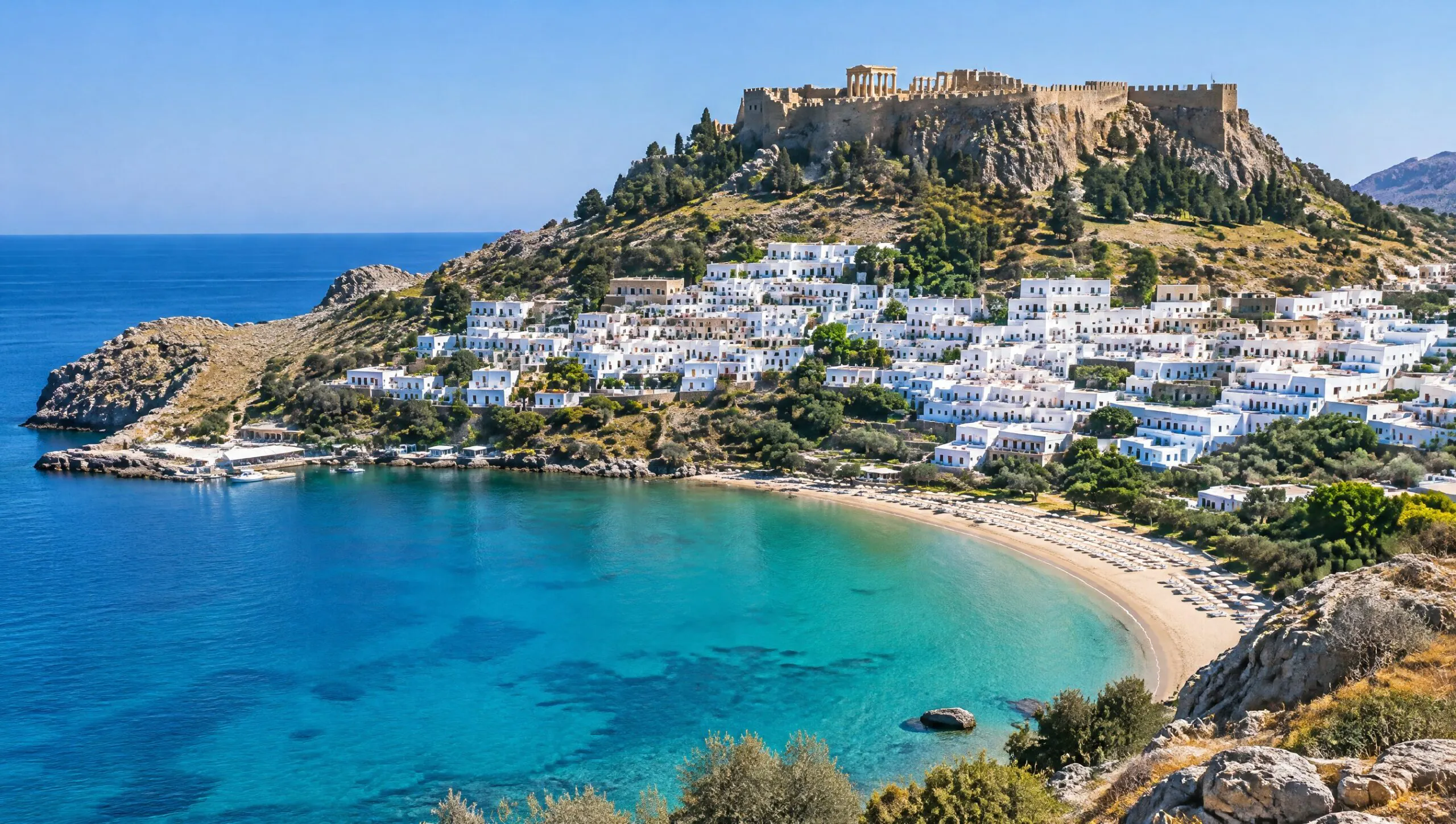
The island itself is 1,400 square kilometres and varies accordingly. The north holds the town, the airport and the resort strip at Ixia and Ialysos. The east coast runs down through Faliraki and Afandou to Lindos, the white village under an acropolis that is the island’s most photographed place. The west is windier and quieter, the south around Prasonisi almost empty.
A season that runs from April to November
Rhodes airport takes direct flights from across Europe for seven or eight months of the year — a genuinely longer window than the Cyclades, which matters both for use and for letting. Ferries connect to Piraeus, Crete and the other Dodecanese islands, and Marmaris on the Turkish coast is an hour by catamaran.
The climate helps. Rhodes is far enough south and east to swim comfortably from May into early November, which is why the hotels stay open when Mykonos has shut.
That length of season changes the arithmetic of ownership. A house used for eight months is a different asset from one used for ten weeks, and the running costs are spread across far more of the year.
Which part of Rhodes to choose
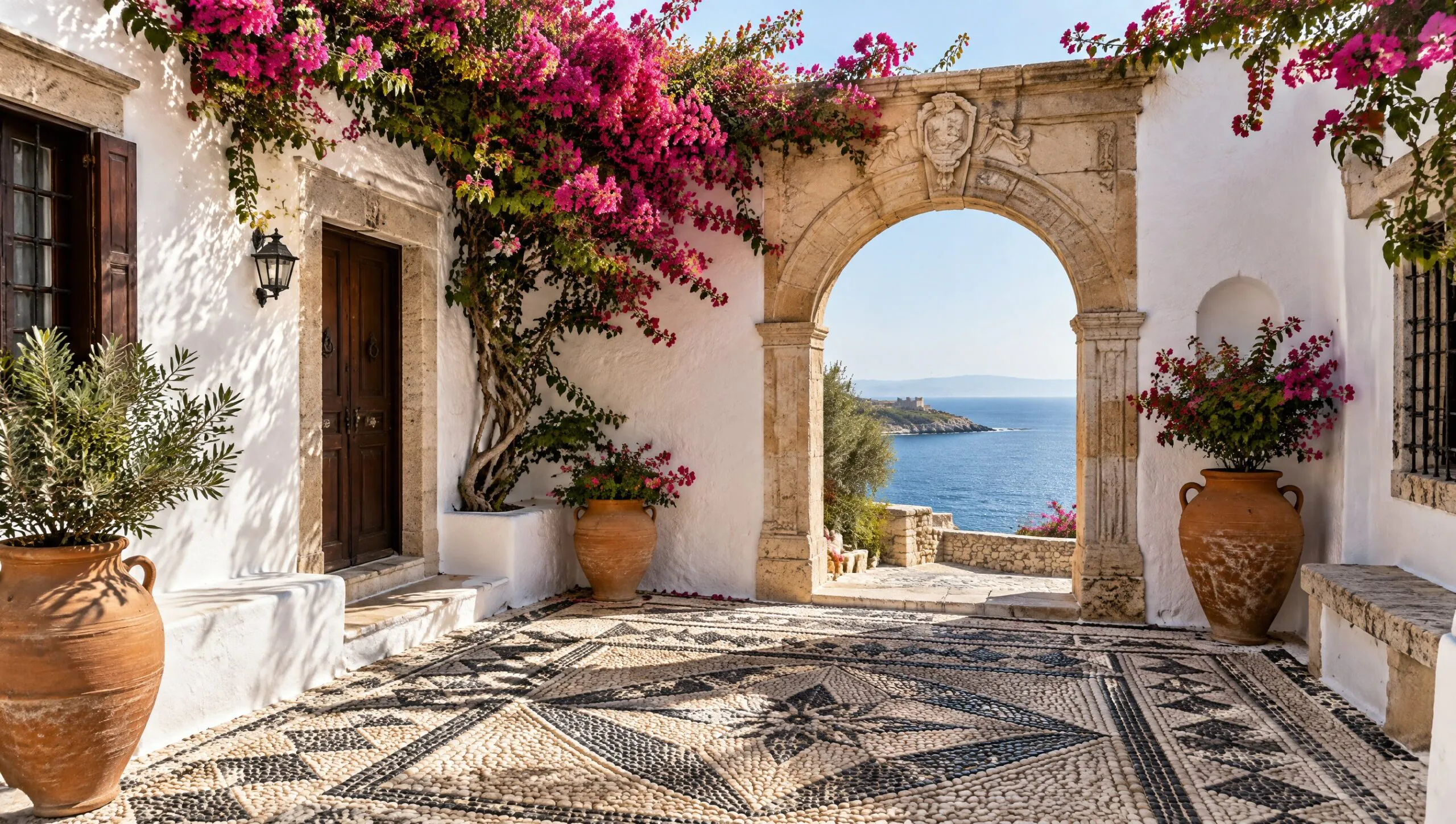
Lindos. The white village below the acropolis, where captains’ houses with pebble-mosaic courtyards sell for more than anything else on the island. Strictly protected, tightly held, and unlike anywhere in the Cyclades.
Pefkos and Vlycha. Immediately around Lindos, with the same bay and a fraction of the planning difficulty. The sensible place to buy if Lindos itself is out of reach.
Rhodes Old Town. Living inside the walls: medieval houses, strict conservation rules and an address nobody can replicate. Restoration is slow and archaeologically supervised.
Ixia and Ialysos. The north-west strip near town, with the hotels, the windsurfing and the best services. Apartments here are the most liquid stock on the island.
Kallithea and Faliraki. The east coast close to town, with the Italian-built thermal baths at Kallithea and the busiest beaches on Rhodes. Easy letting, mass-market neighbours.
Afandou and Archangelos. Between the town and Lindos, with a golf course, long beaches and working villages behind. The best value on the east coast.
The west and south. Monolithos, Kattavia, Prasonisi — wind, space, castles on cliffs and almost no foreign ownership. Very cheap, and a long way from an airport.
Why buyers choose Rhodes
The season, and the infrastructure that comes with it. Rhodes supports a city of fifty thousand people, with hospitals, schools and flights almost all year. A house here is usable for eight months rather than three, and lettable for most of them: good properties on this island run at roughly 160 to 180 let nights a year, which is a different asset from a Cycladic villa earning its keep in eight weeks.
The second reason is that it is not Cycladic. The architecture is medieval, Ottoman and Italian rather than white and blue, the island is green in the north, and buyers who have seen enough of the Aegean postcard often find this a relief.
The investment case, stated plainly
Rhodes has one of the longest letting seasons in Greece and the deepest tourism infrastructure outside Athens and Crete, which makes rental income steadier here than almost anywhere. Gross yields of four to seven per cent are realistic on well-chosen stock. And entry prices are genuinely well below the Cyclades for comparable sea views: median asking prices on Rhodes sit around €2,210 to €2,500 per square metre against roughly €4,060 across the Cyclades. Lindos and Pefki carry a premium of perhaps thirty to forty per cent over the less touristic parts of the island, and quality construction costs €1,800 to €2,200 a square metre — which is the number that decides whether a cheap old house is actually cheap.
The honest caution is the border zone. The Dodecanese are a designated border region, and non-EU buyers need approval from the Greek Ministry of Defence before they can complete. It is routinely granted, but it adds time and paperwork and it must be started early. EU buyers are unaffected.
The second caution is that much of the coast is genuinely mass-market. The strip from Ixia to Faliraki is built for volume tourism, and a property there will always be valued as holiday stock rather than as a home. If character matters, look south of Afandou.
Questions we get about Rhodes
What exactly is the border-zone rule? Non-EU nationals buying in the Dodecanese must obtain ministry approval. The application is routine, we handle it, and it typically adds a few weeks. Start it when the offer is accepted, not later.
Is Rhodes in the lower Golden Visa band? No. The €800,000 threshold applies to every Greek island with more than 3,100 inhabitants, and Rhodes has around a hundred and twenty-five thousand, so the higher band applies with a 120 m² minimum. The one route to a lower figure is the €250,000 band for commercial-to-residential conversions and listed-building restorations — which, in a town with six thousand residents inside a UNESCO-listed wall, is worth examining properly. We check the current text against the specific property.
Can I restore a house in the Old Town? Yes, with archaeological and conservation approval. It is slower and more expensive than ordinary renovation, and the result is an asset nothing else matches.
Did the 2023 wildfires affect property? They affected parts of the south-east interior around Laerma and Asklipio. The coast and the main resort areas were not burned. We will tell you plainly if a property is in an affected zone.
How long does a purchase take? Ten to fourteen weeks for a non-EU buyer including the ministry approval; eight to twelve for an EU buyer with clean title.
Buying in Rhodes
Our stock here is still small and we are building it deliberately rather than quickly. If you are a non-EU buyer, tell us at the outset so we can start the approval alongside the search rather than after it.
Browse what is available below, or send us the area and budget you have in mind.
Currently for sale in Rhodes
 Homes for Sale GreeceAI concierge