
Mykonos took 780,385 air arrivals between January and September this year, 5.6% more than the same stretch of 2025. Private jets brought 5,089 passengers, up 1.7%. Hotels ran at 83.4% occupancy in July against 82.4% a year earlier.
Those are good numbers. They are not the interesting ones. The interesting number is that American arrivals to Greece fell 8.2% over the same period — and American spending rose 7.9%.
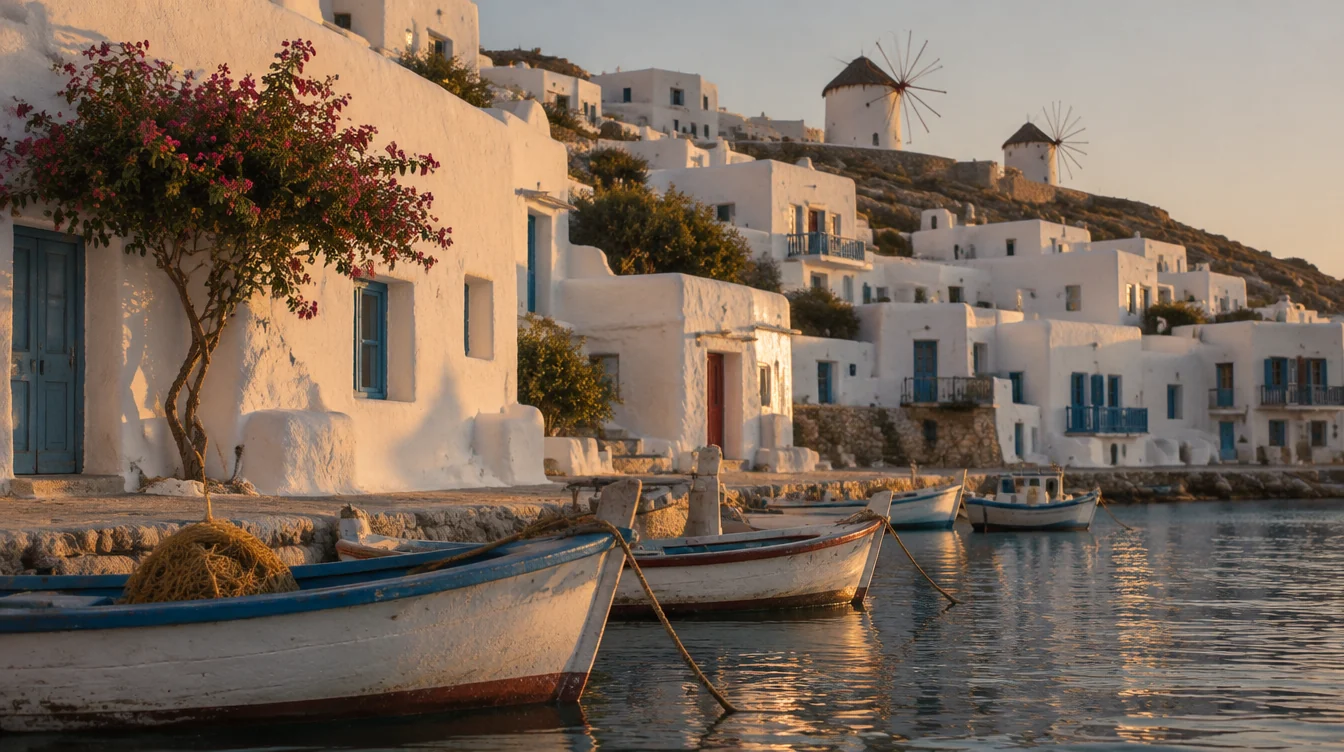
Fewer Americans, more American money
Between January and July, 830,000 US visitors came to Greece, down from the year before. They spent €1.06 billion, up on the year before, at an average of €1,280 a head.
That is not a market in retreat. That is a market trading up: a smaller number of higher-spending visitors replacing a larger number of lower-spending ones. For anyone who owns property on Mykonos and lets it, that distinction is the whole game. Volume tourism fills beds in August. Spend-per-head is what sustains a nightly rate in June and September.
The hotel figures say the same thing from the other direction. The average daily room rate on Mykonos in July was €190, against €168 in July 2025 — a 13% rise. Average length of stay slipped from 4.8 nights to 4.7. Guests are staying marginally less and paying materially more.
What the rental forecasts say
Short-term rental occupancy on Mykonos is forecast to come in 21% above 2025, with average nightly rates up around 7%. Occupancy rising three times faster than rate is a healthy pattern: it means demand is absorbing supply rather than supply chasing demand with discounts.
The length-of-stay data is the part most buyers miss. On Mykonos the average booking runs seven to eight nights. On the island-hopping circuit it is three to 3.8. A week-long booking and a three-night booking are completely different businesses — different cleaning costs, different turnover risk, different margin on the same headline rate.
If you are modelling a rental return on a Mykonos house, the seven-night average is the single most valuable number in this entire dataset, and it is the one nobody quotes.

The national picture underneath it
Greece took 20.04 million visitors between January and July, up from 18.45 million. Travel revenue reached €13.52 billion, a 12% rise. Revenue is growing faster than arrivals, which is the healthiest shape a tourism economy can have.
One figure deserves more attention than it gets: Greece ranks 13th globally among destinations Americans consider for a holiday, and fourth in the Mediterranean — behind Italy, France and Spain. For a country that has just been voted the best in the world by Condé Nast Traveller’s readers, fourth in its own sea is a gap between reputation and habit. Gaps like that tend to close.
Why Mykonos keeps its position
A survey of more than 450 luxury travel professionals across New York, Los Angeles, Miami, Chicago, Washington, Toronto and San Francisco named Mykonos as the Greek luxury destination. Not one of them. The one.
That matters for property in a way it does not matter for hotels. When the trade in seven major North American cities defaults to the same island, the buyer pool for a house there is permanently international and permanently deep. It is why a well-bought Mykonos property finds a buyer at short notice when a comparable house on a quieter island waits — and it is most of what the Mykonos premium actually buys.
What we would take from it
The case for Mykonos in 2026 is not growth. Arrivals up 5.6% is solid, not spectacular. The case is pricing power and liquidity: a 13% rise in room rates, rental occupancy forecast up 21%, a week-long average stay, and a buyer pool that the entire US luxury trade points at by default.
The honest caution is unchanged. Entry prices are the highest in Greece, the season still does most of its work in a narrow window, and yield assumptions built on August rates will disappoint. Build the model on the shoulder months or do not build it.
We hold listings on Mykonos and across the Cyclades. If you want the figures for a specific house rather than the island average, tell us what you are looking for.
Figures: Mykonos and national tourism data for 2026 as reported by newmoney.gr. The analysis and the conclusions drawn from the data are our own.